
Teotihuacan Pyramid of the Moon, Completed in 250 C.E., Mexico City, Mexico
Teotihuacan is believed to be the first large chief city of an abandoned civilization in the Americas. Despite the large remaining infrastructures of the city along and hieroglyphs that line the walls of some structures, we have little to no idea on the base information of the Teotihuacan people. Even what they originally called themselves is still a mystery to archaeologists. With a lack of evidence for what their structures were designed for, we can only speculate the importance and meaning behind certain structures. Artifacts surrounding the site as well as similar ones across Mexico lead researchers to believe that the Teotihuacan civilization was a powerful one that participated in trade with other cities.
While we do not know much about the Teotihuacan culture, we have learned a little bit about this abandoned city, more specifically, the Pyramid of the Moon. The Pyramid of the Moon lies in the Western part of the city, at the end of the main road (Commonly called the Avenue of the dead because the Aztecs believed the city was surrounded by tombs but, because this is not proven, I will refer to it as the main road) and stands a total of 141 feet tall. It is speculated that it could have been even taller with wooden support and structures at the top that has long since been destroyed. While it's true purpose to the historical narrative isn't concrete, excavations done on the base of the pyramid staircase give us insight into possible purposes of it. The excavation exposed a tomb of a man with goods such as greenware, obsidian, and sacrificial animals. While the Pyramid of the Sun on the south of the main road has repeatedly been called the "birthing place" of this culture, or the place of "emergence," the Pyramid of the Moon seems to have a different narrative, where sacrifices occur and important individuals are buried.
The name of the Pyramid itself gives an insight into its purpose, as for centuries other cultures have believed the moon to be the resting place of the dead, the night sky a final resting place for your loved ones. For example, in early Hindu practices, it was believed that souls went to the moon to await their rebirthing, following the moon cycle from death to rebirth (new moon to full moon). In another example, the Ancient Greek religious practice, it was believed that the moon was the home of the dead.
In the end, we do not know much about the Teotihuacan culture, or even what their true name was. However, we can speculate the meaning of the remains by making connections to other cultures in the area and across the globe.
Sources:
Department of the Arts of Africa, Oceania, and the Americas. “Teotihuacan: Pyramids of the Sun and the Moon.” In Heilbrunn Timeline of Art History. New York: The Metropolitan Museum of Art, 2000–. http://www.metmuseum.org/toah/hd/teot2/hd_teot2.htm (October 2001)
Dr. Maya Jiménez, "Teotihuacan," in Smarthistory, December 17, 2015, accessed November 18, 2020, https://smarthistory.org/teotihuacan-2/.
History.com Editors. “Teotihuacan.” History.com. A&E Television Networks, January 5, 2018. https://www.history.com/topics/ancient-americas/teotihuacan.
Wednesday, November 18, 2020
The Pyramid of the Moon

Friday, November 13, 2020
Nose Ornaments of the Northern Muche
 |
| Nose Ornament with Intertwined Serpents, Moche, Peru, 390-450 C.E., The MET |
“Nose Ornament with Intertwined Serpents.” metmuseum.org. Accessed November 13, 2020. https://www.metmuseum.org/art/collection/search/313400.
Wednesday, November 11, 2020
The Were-Jaguar
 |
| Olmec Were-Jaguar, Museo Regional de Antropologia at Villahermosa, 1500 to 400 BCE. |
When examining ancient cultures and their remnants such as statues, decaying buildings, old clothing, the primary purpose are to understand how they lived their lives. The present can easily become the past and because of that, learning from the past is one of the easiest ways that we as humans have to understand people that are different from us.
The Olmec was a civilization that flourished in early Mesoamerica from around 1500 BCE to around 400 BCE. The Olmecs were known as the ‘mother culture’ of Mesoamerica, and thus, to understand them, we are able to understand the civilizations that were influenced by the Olmecs in an easier way. The quickest method of understanding a culture is through its religion. Religion forms social structures and helps unify people, making people share a set of beliefs and practices. This sharing of beliefs and practices allows for a sense of trust and respect, allowing civilizations to be built. Because of this, that is why we are examining the Were-Jaguar sculpture.
The Olmec religion was primarily centered around 8 gods: the maize god, the rain spirit, the feathered serpent, the bird monster, the banded eye-god, the shark monster, the Olmec dragon, and finally, the Jaguar. The jaguar was the shaman of the animal world, referred to as the Nahual, which was the title given to those that were the animal form of a god. Outside of this importance for spirits, they believed that the jaguar was a deity of fertility and rain as well as the embodiment of the living and the dead. Jaguars were believed to be the most powerful and feared animal to the Olmecs, so they held a lot of titles in the Olmec religion. A common practice was to ‘transform’ into a were-jaguar as a common practice of Shamanism during this time. Singing and chanting to the Jaguar deity would occur followed by the Shaman dancing and chanting to the spirit world, at the end of it, it was believed that the man would be half-human, half jaguar.
The sculpture above is a symbol of this transformation. The Were-Jaguars are often depicted with wide noses, slanted eyes, and a cleft head. It is believed that the meanings of the statues have changed over time, from altars for gifts to the jaguar god to reminders to the Olmec people as a form of symbolization of the religion itself. By examining these sculptures, we can learn about the importance of them in the society they derived from, thus learning from the past and have a roadmap to learn in the future.
Sources:
“ The Olmec Gods.” Ancient Indian Civilizations. Accessed November 11, 2020. https://www.aaanativearts.com/ancient-indians/olmec-gods.htm.
Cartwright, Mark. “Olmec Civilization.” Ancient History Encyclopedia. Ancient History Encyclopedia, November 9, 2020. https://www.ancient.eu/Olmec_Civilization/.
Wednesday, November 4, 2020
Lydenburg Heads
 |
| Lydenburg Head, Lydenburg, South Africa (500 C.E.) |
The Lydenburg Heads were a series of seven terracotta sculptures found in Lydenburg, South Africa. The heads themselves are very unique with different types of mouths, eyes, head shapes, and more varying in each sculpture. But what I find most interesting is the lack of knowledge that the United States has on them. These sculptures are surrounded by a lot of questions in the United States, several sources explaining that these were almost like helmets to the people of South Africa, believed to be used for initiation ceremonies and other types of ceremonies such as religious ones, but nothing concretely supported by culture and historical research. To try and get past all of the questions surrounding these sculptures, I went to the website for Iziko, the South African museum that holds these artifacts. Attached to the information on their display is a video where the archaeology director of the museum and an archaeology professor of Cape Town's University discuss the true meaning behind these sculptures.
The people who carved the Lydenburg Head sculptures arrived in South Africa around 2,000 years ago and are believed to be Bantu speakers. They were also great craftsmen in pottery and metallurgy, living in villages and surviving mostly off of their farming rather than their crafted goods. The makers of these heads are believed to be senior matriarchs of the community, however, because the evidence is scant regarding these people, it is only a guess. This guess is based upon what has been observed by Bantu language cultures in Africa. Pottery is considered women's work, while metallurgy was considered men's work. These women are believed to have been teachers to younger generations, who would use these sculptures in shows (like a play) to teach the children of the time about responsibility and their roles in the culture. Two of the heads are large enough to be worn by people, while the other five were believed to be placed on poles, similar to puppets on sticks.
Each head itself is very important, six of them appearing human while the seventh one is designed to resemble an aardvark. This animal is featured in a lot of creation stories in African cultures, which is why it is commonly believed that this is used as a rite of passage into adulthood. The heads were originally found broken, believed to not have been broken as a result of time or a raid of some sort, but an end of this rite of passage. It was the end of childhood and the surfacing of adulthood in the youth of this culture. And that is why these sculptures are so significant to the historic narrative. They are designed to guide children from childhood to adulthood and combine religious teachings with communal responsibility. To learn how society has changed over the years, we first need to understand where it was five, ten, twenty, a thousand years ago.
Sources:
Department of the Arts of Africa, Oceania, and the Americas. “Lydenburg Heads (Ca. 500 A.D.).” metmuseum.org. The Metropolitan Museum of Art, October 2000. https://www.metmuseum.org/toah/hd/lyde/hd_lyde.htm.
“Looking A Head: Revisiting the Lydenburg Heads.” Iziko Museums of South Africa. South Africa: Agency of the Department of Arts and Agriculture. Accessed November 4, 2020. https://www.iziko.org.za/exhibitions/looking-a-head-revisiting-lydenberg-heads.
Friday, October 30, 2020
The Kingdom of Ife
 |
| Shrine Head, Yoruba, Nigeria 12-14th century |
The Yoruba people are an ethnic group of Western Africa, and these individuals trace their lineage to the site of Ife, the place of all creation in the Yoruba religion. For hundreds of years, the Yoruba people have held onto the belief that the person's Iwa, the character, reflected the person's inner energy, the Ase. This inner energy resided in the head of the body, which is a reason why so many remaining ancient art pieces are of the head and neck rather than a whole body. Because of this belief, people who held high amounts of power such as kings or chiefs had to wear veils, to conceal what was believed to be a dangerous level of Ase. Outside of the face covering, the Ase is represented in a cone shape, which is reflected in the headdresses that Ife sculptures wear. This background brings us to the sculpture presented above.
This sculpture is of a semi-tranquil person, their expression neutral and calm looking, representing the character of the individual, a reflection of the Iwa. Lines decorate the face but avoid the lips, which leads us to the misconception that often surrounds African art. These lines are commonly misinterpreted as scarification, a religious rite of passage symbol in the culture. However, the Yoruba religion does not involve scarification, but despite this, people still believe that scarification is the meaning behind the lines. Looking past this misconception and into the Ife way of life, these lines weren't scars but semi-permanent markings that indicated the status of the elite in this society. The artwork itself for a long time was misinterpreted by Europeans, who believed that African individuals could not make beautiful realism, which is why it was often mistaken as pieces of European art left behind from the Trans-Saharan trade. The individual of this sculpture was very important to the Yoruba religion and to the Kingdom of Ife, providing us insight into the past and present beliefs in this religion.
Today, Ife remains one of the major religious places for the Yoruba people. The art that remains from the Kingdom of Ife is not only a historical object for achievements of the past, but continue to serve as a regional and religious unifier amongst the Yoruba people that are spread across West Africa, proving it's importance to society and the world around it. Not only does it symbolize a change in the art world from 'what is expected' for African based art, but it also shows how advanced kingdoms such as the Ife get erased from our history books, another reason why it is important to the historical narrative.
Sources:
Dr. Christa Clarke, "Historical overview: to 1600," in Smarthistory, September 21, 2016, accessed October 30, 2020, https://smarthistory.org/historical-overview/.
"Kingdom of Ife: Sculptures from West Africa," in Smarthistory, September 19, 2016, accessed October 30, 2020, https://smarthistory.org/kingdom-of-ife-sculptures-from-west-africa/.
“Shrine Head, Ancient Yoruba | Minneapolis Institute of Art.” Minneapolis Institute of Art. Minneapolis Institute of Art. Accessed October 30, 2020. https://collections.artsmia.org/art/4866/shrine-head-ancient-yoruba.
Wednesday, October 28, 2020
The Stelae of Axum
 |
| Stelae of Axum, landmark of Axum, Ethiopia. |
The Kingdom of Axum was founded in the early first-century common era, flourishing until the ninth century in the horn of Africa, now known as modern Ethiopia, Eritrea, Sudan, Djibouti, and southern Yemen. The heart of this kingdom was in Axum, Ethiopia. The Stelae of Axum are a series of granite monoliths in the heart of the Kingdom of Axum. The stelae range from heights anywhere from seventy feet to well over one-hundred feet, an achievement in itself because the stelae are singular shafts of granite. The slab of granite is carved in a peculiar fashion, with fake doors carved at the bottom, log-like flooring carved above it to symbolize a new floor of the tower, then several tiers of carved windows. Each stela is oblong, not square like at all, with a crescent and disk symbol adorning the top. While it is well documented that the carved symbols are religious, the meaning of the symbols can only be speculated. The Axum people were pagans up until the fourth century when the new king declared the kingdom Christian. Because of this, we cannot speculate the symbols in terms of Christianity, but rather paganism. Looking at the symbology of ancient paganism, the symbol of the crescent is a symbol commonly used to represent the phasing from life to death. While a disc symbol can either represent a sun or the shift from mortality to divinity. The true purpose of these stelae is unknown but given the symbology and the placement of them the stelae are widely accepted and believed to serve as grave markers or memorials to important members of society in the third to the fourth-century common era.
 |
| Obelisk of Axum, Henry Salt (1809) |
The Axumites put a lot of time, effort, and capital into the creation of the stelae. Each stelae was designed around the person who was being buried. For example, when a king was buried he would have a stelae that were around thirteen stories tall, while a lord would have one that was around two stories tall. The grander the stelae, the grander the title of the individual. That is why the stelae of Axum hold importance to the overall historical narrative. Grave markers are important to society, they are symbols of remembrance for loved ones and have been used for thousands of years. The way people are buried and how their grave is decorated gives an insight into the culture and society that the person once lived in. Across the world, we all have different cultures and ways of doing things such as celebrating our dead. Latin cultures have holidays such as Dia De Los Muertos (the day of the dead) where they go visit the graves of loved ones and make altars for them, while in India they celebrate their ancestors' souls through a holiday called Shradh, not visiting a grave because in Hindu culture most bodies are cremated. These stelae give an insight into the culture of the Axum kingdom before it fell under Christian control, how they remembered their dead, making it vital for it to not be buried under the narrative of Christian gravemarkers. These monoliths are one of the last remnants of this ancient Kingdom and its practices.
Citations:
Butzer, Karl W. “Rise and Fall of Axum, Ethiopia: A Geo-Archaeological Interpretation.” American Antiquity, vol. 46, no. 3, 1981, pp. 471–495. JSTOR, www.jstor.org/stable/280596.
Lipsky, George A. (George Arthur). Ethiopia: Its People, Its Society, Its Culture. HRAF Press, 1962, accessed October 28, 2020, https://academic.oup.com/afraf/article-abstract/62/247/172/75627?redirectedFrom=fulltext.The British Museum, "The kingdom of Aksum," in Smarthistory, September 23, 2016, accessed October 28, 2020, https://smarthistory.org/the-kingdom-of-aksum/.
Friday, October 23, 2020
Wu Zhen
 |
The Fisherman (Wu Zhen 1350 C.E.,) The aim of Chinese paintings are to evoke inner essences, emotions, energy, and life. Contrary to what one might think, to accomplish this, the painter would choose to not use color. Each brushstroke is considered a piece to a balanced yet dynamic whole of the painting. This is a reflection of Chinese calligraphy practices, each brushstroke matters and requires a disciplined hand. China during the 1300s didn't necessarily have regular artists. Most artists were scholars that shifted from calligraphy to painting, using the same brushes and ink they would use for calligraphy for painting. These scholar-artists would use their calligraphic training and brushwork to express symbolism, style, and their own beliefs and feelings of the world around them. |
Sources:
Hearn, Maxwell. “Chinese Painting | Essay.” metmuseum.org, June 2008. https://www.metmuseum.org/toah/hd/chin/hd_chin.htm.
“Wu Zhen | Fisherman.” metmuseum.org. Accessed October 23, 2020. https://www.metmuseum.org/art/collection/search/41468.
“Wu Zhen: Chinese Painting.” China Online Museum, August 12, 2017. https://www.comuseum.com/painting/masters/wu-zhen/.
Wednesday, October 21, 2020
Goryeo Celadon
 |
| Melon-Shaped Ewer with Bamboo Decoration, 12th century Korea |
As discussed in our weekly intro video, there was a lot of communication between China, Korea, and Japan, so this type of ceramic making spread through the three countries, each having their own distinctive looks and aesthetics to them. Korean celadon specifically is known for its naturistic design. These designs would have decorations beneath the glaze, incisions filled with black and white liquified clay (used as paint). While ceramics don't really strike the average person as significant, what makes celadon so important to Korean history and culture is because it signifies a cultural and technological shift in Korea. The technology for the kiln and the glaze production for celadon was something that previous Korean dynasties were getting towards, but without political connections to China, Korea would have taken a lot longer to develop the technology on their own to create such artwork. Alongside this technological shift, we can also view the ceramic pieces to determine what was appreciated during this time and why. For example, the Goryeo dynasty was the last Buddhist dynasty of Korea, which can explain the naturistic art decoration on their ceramics as well as the reason why print and papermaking were so important, to produce Buddhist texts for the public.
Sources:
“Korea, 1000–1400 A.D.” In Heilbrunn Timeline of Art History. New York: The Metropolitan Museum of Art, 2000–. http://www.metmuseum.org/toah/ht/?period=07®ion=eak (October 2001)
The Editors of Encyclopaedia Britannica. “Celadon.” Encyclopædia Britannica. Encyclopædia Britannica, inc. Accessed October 21, 2020. https://www.britannica.com/art/celadon.
“Melon-Shaped Ewer With Bamboo Decoration.” metmuseum.org. The Metropolitan Museum of Art. Accessed October 21, 2020. https://www.metmuseum.org/art/collection/search/42268.
Wednesday, October 7, 2020
Warefare, Looting, and the Art Market (Ethical Question Blog-Post)
 |
| Remnants of a looted statue, Koh Ker Cambodia |
Ethical Questions to Answer: How has warfare looting affected Cambodia's cultural heritage? How has the history of looted continued to hurt Cambodia to this day?
Please note: The Vietnam Conflict is what people commonly know as the Vietnam War. War was never declared on Vietnam nor the Viet Cong, thus, we cannot call it the Vietnam War and must call it the Vietnam Conflict.
Warfare destroys communities and families within them. Separation, destruction of economic and social fabrics, and the destruction of cultural past are just a few examples of what occurs because of war. Cambodia is a country that has felt all of these and then some. The Vietnam conflict was a pivotal point for Cambodia's culture. The Khmer Rouge, a title given to members of Cambodia's communist party, provided protection to cultural and heritage sites.
When the Vietnam conflict began and Vietnam began to invade Cambodia, these places lost their protection from looting and destruction when the Khmer Rouge fled to Thailand. Heritage sites filled with cultural stories and statues became a place of destruction and looting. This not only affected Cambodia's culture but their economic system. These sites were considered not only archaeological evidence that provided context for research on the history of Cambodia, but they were also considered places for tourist revenue. With the lack of safety at these sites along with the looting, less money was produced from these sites and became difficult to fund in terms of upkeep and safety provision measures. Because of the direct effect on the economic system of Cambodia, the looting halted the preservation and continuation of the knowledge of Cambodian culture.
Despite the ending of the Vietnam Conflict, the looting of Cambodia hasn't stopped. Khmer antiquities are considered valuable collectibles, and while looting is no longer done on an extreme level like the amounts taken during the Vietnam conflict, these artifacts are still looted to fund organized crime organizations. People are told that if they wanted any piece of a temple that they can take a picture of it and the organizations will arrange for it to be looted and delivered to them. This ongoing looting of these sacred temples is not only harming Cambodia culturally but economically. Fewer artifacts within temples mean fewer tourists who want to pay to travel to them, thus hurting Cambodia's economic growth (That still hasn't fully recovered from the Vietnam Conflict). Culturally, Cambodia's youth cannot learn from the past, the temples are not safe for active worship, nor are they able to provide insight into the culture's past for archaeological purposes.
Overton, Leonard C., and David P. Chandler. “Vietnamese Intervention.” Encyclopædia Britannica. Encyclopædia Britannica, inc., December 9, 2019. https://www.britannica.com/place/Cambodia/Vietnamese-intervention.
Seiff, Abby, and Phnom Penh. “How Cambodia's Temples Fell to Looters: DW: 25.06.2014.” DW.COM, June 25, 2014. https://www.dw.com/en/how-cambodias-temples-fell-to-looters/a-17735835.
Tess Davis and Dr. Steven Zucker, "The Looting of Cambodian Antiquities," in Smarthistory, October 27, 2017, accessed October 7, 2020, https://smarthistory.org/looting-cambodia-2/.
Monday, October 5, 2020
Meenakshi Amman Temple
 |
| Lord Shiva (Left) and Ganesh (Right) South tower, Meenakshi Amman Temple (6th Century B.C.E.,). Madurai, Tamil Nadu, India. |
Temples are structures designed for religious or spiritual activities such as prayer, worship, meditation, To understand the importance of each temple, we must understand the history behind the creation of each temple. This temple, in particular, is named Meenakshi Amman. Meenakshi Amman is a temple built in the 6th-century B.C.E., in Madurai, a major historic city in the South Indian state of Tamil Nadu. According to Hindu legend, the royal couple King Malayadwaja Pandya and his wife, Queen Kanchanamalai prayed to Lord Shiva for a son to pass their throne down to. Instead of a son, Lord Shiva sent them the Hindu Goddess Parvati (goddess of fertility, love, beauty, harmony, marriage, children, devotion, divine strength, and power) in the form of a three-year-old, three-breasted girl whom the couple then named Meenakshi. The royal couple was told by a divine voice that the daughter's third breast would disappear when she would meet her husband. Later on in life, Meenakshi met Lord Shiva, and her third breast went away. Knowing that this was her destined husband, the two married in the temple now known as Meenakshi Amman Temple.
 |
| Meenakshi Amman Temple, 6th Century B.C.E., Madurai, Tamil Nadu, India |
Because this temple is known as the marriage site for Lord Shiva and Goddess Parvati, the temple is very sacred. It is one of the oldest and most important temples in India, not only providing religious insight but cultural insight with the structure itself. Temples in the Hindu religion, like temples of other religions, hold great cultural importance. Designed to look like mountains, the temples are believed to be the linkage of heaven and earth, for mountains are believed to be the top of the world's axis. The symbolism in their structure designed to bring humans and gods together. The art decorating the temples are designed to not only tell the stories surrounding the Hindu religion but to reinstall the beliefs and ideas of Hinduism to the followers of the said religion. The way the structure was created and the materials used provides insight into the daily lives of the people of the past, how they thought to use certain items and how they learned to craft things in such a way to last a long time.
Temples hold various reasons for importance, whether it be a place of religious significance such as a wedding between to gods or a place where a god was believed to descend from, they all hold cultural importance to the society where the temples remain in. Decorated with art that re-instill the beliefs of this culture, the temples from years ago reinforce a sense of connection to the past, their religion, and their culture.
Sources:
“Meenakshi Amman Temple Madurai - History, Architecture, Timings.” Cultural India. Cultural India. Accessed October 6, 2020. https://www.culturalindia.net/indian-temples/meenakshi-temple.html.
Asian Art Museum, "Beliefs made visible: Hindu art in South Asia," in Smarthistory, January 27, 2016, accessed October 5, 2020, https://smarthistory.org/beliefs-made-visible-hindu-art-in-south-asia/.
Saturday, October 3, 2020
Art Shift from Paganism to Christianity
 |
| Adam and Eve Reproached by the Lord, bronze panel from the doors commissioned by Bishop Bernward, at St. Michael's Church, Hildesheim, Germany (1015 C.E.,) Key Takeaway- Italicized |
The sculpture above depicts the change between art styles. This sculpture is known as "Adam and Eve Reproached by the Lord", it is a bronze panel for doors commissioned for St. Michael's Church in Germany. In contrast to naturalist/realistic artwork, there is no emphasis on Eve's woman-like features or the muscles of Adam, but instead, the focus is placed on the gestures to share the story of God interrogating Adam and Eve about eating the apple, before the expulsion from paradise. The passing of the blame of God pointing to Adam, Adam pointing at Eve, and Eve pointing to the serpent for why they ate the apple. A simplified art style serves the purpose of storytelling and communication, for you aren't looking at the artwork as if they are real people, allowing you to grasp the larger picture of the story instead. This method was a way to further spread the theology of the Christian church, which is why it is important to Art history as a whole. Art influences our society, not only reflecting the change of views of the society but during these changes art is used as a tool to further the change of views, instilling values that weren't there before.
Sources:
Dr. Nancy Ross, "A new pictorial language: the image in early medieval art," in Smarthistory, August 8, 2015, accessed October 3, 2020, https://smarthistory.org/a-new-pictorial-language-the-image-in-early-medieval-art/.
Dr. Nancy Ross and Dr. Jennifer Freeman, "Bronze doors, Saint Michael’s, Hildesheim (Germany)," in Smarthistory, December 11, 2015, accessed October 3, 2020, https://smarthistory.org/bronze-doors-saint-michaels-hildesheim-germany/.Ship Burials
 |
| The Sutton Hoo ship excavation in 1939, early Anglo-Saxon, early 7th century, Suffolk, England |
Ship burials were common in paganistic cultures, commonly seen in Germany, Norway, and other Germanic/Scandanavian societies. These ships would be fully equipped with money, jewelry, personal items, and other things that are deemed necessary for the person to have a good afterlife. Boats are a vessel of travel for many individuals, and during this time period, they were believed to be a trusted safe passage for many. Because they were believed to be so safe and so reliable, they symbolized a safe passage to the afterlife. Not only were they buried in ships, but they were buried in ships that they have used to travel during their days amongst the living.
Because of the origin of these burial rituals, it is rare to see them outside of Scandanavian and Germanic countries, however, Sutton Hoo was an exception. Believed to be buried in the early seventh century, Sutton Hoo has several mounds of grassland that were designed as gravesites. Buried in one of the mounds was King Raedwald. His burial was unlike the others, instead of being in a normal tomb-like grave with his belongings, he was buried in a ship. This is important to note because of the fact that Raedwald was pagan before converting to Christianity, making it seem like he reverted back to his original belief system.
The ship Raedwald was buried in was 88 feet long, the longest to date for Ship Burials. This provides insight into his role as a king and how the people around him viewed him as a political figure. The larger the ship was, the more important and renowned by the people they were. Within the burial site were Byzantium silver dishes, solid gold coins, a bronze bowl from the Middle East, along with cups and spoons inscribed with Greek lettering. These were all placed in the site to show the contacts this king held across the world, how important they were seen to other cultures. Because Medieval Anglo-Saxon kings were predominantly Christian, the way this king was buried is important. When Christianity began to sweep its way across Europe, Paganists were viewed as heathens who were not tolerated by the church, especially the Byzantine, who had laws describing punishments for those found out to be pagans in secrecy.
So why is any of this important to history? Why should we care? The main answer to both of these is the insight provided by examining burials and how the individuals were treated. Burials were always a symbol of importance to society. Whether it be something as simple as cremation, or the act of burying your dead in a tomb, there is significance to the act of caring for the dead. Rituals provide ways for individuals to express their grief in culturally acceptable ways, it provides a sense of support for the mourners and allows the beliefs of the dead and the living to carry on. The key takeaway for this is how beliefs are carried on through burials, but also finished with them. This was one of the last kings to be buried in a paganistic fashion while the rest of Europe converted to Christianity.
Citations:
The British Museum, "Sutton Hoo Ship Burial," in Smarthistory, March 3, 2017, accessed October 3, 2020, https://smarthistory.org/the-sutton-hoo-ship-burial/.
The Editors of Encyclopaedia Britannica. “Sutton Hoo.” Encyclopædia Britannica. Encyclopædia Britannica, inc., March 13, 2020. https://www.britannica.com/place/Sutton-Hoo.
Friday, September 25, 2020
Dome of the Rock
 |
| The base of the dome, Dome of the Rock, 687, Jerusalem |
The Editors of Encyclopaedia Britannica. “Dome of the Rock.” Encyclopædia Britannica. Encyclopædia Britannica, inc., August 5, 2020. https://www.britannica.com/topic/Dome-of-the-Rock.
Wednesday, September 23, 2020
Mamluk Jar
 |
| Mamluk Jar, 14th Century (Produced in Syria) Mamluk S |
The Mamluk sovereignty began to emerge out of a weakened Ayyubid rule in Egypt and Syria, starting in around 1250, known as the Mamluk because of their unusual political system. While other civilizations used slaves, the Mamluk sultanate was the first to incorporate slaves into the governing class of society. This unusual incorporation of slaves into governance is what set them apart, hence why historians refer to them as the Mamluk sultanate, meaning "slave sultanate". The overall reign of this sultanate is divided into two periods, the Bahri reign, and the Burji reign. This piece of artwork was from the Burji reign, 1382 to 1517. The sultans from this time period followed the artistic traditions from the previous Bahri reign, of enameled and gilded glass, inlaid metalwork, woodwork, and textiles. This jar was a white piece of fritware (also known as stonepaste- a ceramic that is mixed with silica, clay, and frit) with blue and black glaze. The only other design on this piece besides the blue and black decorations is a large inscription saying: Lasting glory, increasing prosperity, and good fortune, an uplifting quote considering the plague, civil strife, and famine that provided continual distress to the citizens of this time period. To determine why artwork from this time period is important, we must understand how day to day art such as a jar can affect other places around the world. Mamluk art was prized around the world, most specifically in Europe and Mediterranean countries, where local productions began to mimic the art style of the Mamluk. This is important because a rippling effect occurs. When you have influences of one culture on another, it speaks to their cultural communication and how certain cultural practices and styles come about overtime that may appear unusual in its history of art if you do not realize that one culture was sharing with another. A simple jar can go from looking like a pretty decorative piece that you see in a museum to a link between cultures and their communication, learning things we haven't before. That's why this simple jar is so important to history, it not only provides insight into the culture it originated from, but also provides history to how things evolved in other countries and cultures.
Sources:
Glenna Barlow, "Arts of the Islamic world: The medieval period," in Smarthistory, August 8, 2015, accessed September 23, 2020, https://smarthistory.org/arts-of-the-islamic-world-the-medieval-period/.
“Jar.” metmuseum.org. The Met. Accessed September 24, 2020. https://www.metmuseum.org/art/collection/search/444477.
Yalman, Suzman. “The Art of the Mamluk Period (1250–1517).” metmuseum.org. Heilbrunn Timeline of Art History, October 2001. https://www.metmuseum.org/toah/hd/maml/hd_maml.htm.
Friday, September 18, 2020
The Colossus of Constantine
 |
| The Colossus of Constantine, 312-315 C.E., Roman Empire |
Constantine was an interesting emperor of the Roman Empire. He did not grow up being a successor to a throne or high class enough to be considered a lord, but he somehow became the emperor of the Roman Empire. As his father rose up the political ladder until obtaining Caesar status (Essentially becoming Vice Emperor) in the Eastern half of the empire, Constantine was a member of the Imperial court, becoming a politician as well as a warrior. When Emperors Diocletian and Maximian relinquished the thrones, and when Constantine's father relinquished his throne, Constantine did not become emperor. Instead, Constantine remained in the imperial court, passed over as another person was selected for the title of Emperor. Following a series of wars, betrayals, suicides, and politics, Constantine ended up on the throne of both halves of the empire by 324 C.E. After bringing the empire back together, Constantine changed the capital of the empire, moving it from Rome to Constantinople. This is when the empire began a new turning point, changing in culture and beliefs. This statue here is simply a piece of a gigantic statue of Constantine, estimated to be built around 312 - 315 C.E., carved out of white marble. The body of the sculpture was brick with wooden framework, covered in bronze. The whole sculpture itself is estimated to be around 12 meters tall (40 ft) while the head itself is 2.43 meters (8 ft). Originally it may have looked like this:
 |
| Reconstruction of the Colossus in the Basilica Nova by the University of Virginia |
The purpose as to why this was built can only be speculated because there are no documents defining why it was built. If it was built in a celebration of him, if he requested it built to show the power of the empire, or if it was erected to display his importance in changing the empire, we cannot tell. What we do know, is that Constantine changed the Roman Empire. For years, Rome was a pagan empire, believing in multiple gods that reflected the Greek Pantheon but with different titles. Constantine believed that God guided him and allowed him to become the emperor of not just one half of the empire, but the whole entirety. Believing such, he enforced a change in religion, not only causing an end to pagan traditions in Rome but set down the footwork of how we see Medival Europe develop later on. That is why this piece is important. It provides a benchmark time of when cultures and lives began to change, being a reference point to so many other changes in the world. This statue being built caused a rippling effect, seemingly immediately after it was built there was a shift in art, where we begin to see a cultural allowance to create art depicting religious events and figures of Christianity that we didn't see before.
Sources:
“The Colossus of Constantine.” Joy of Museums Virtual Tours, June 8, 2020. https://joyofmuseums.com/museums/europe/italy-museums/rome-museums/capitoline-museums/the-colossus-of-constantine/.
“Colossus of Constantine.” The Byzantine Legacy. Accessed September 18, 2020. https://www.thebyzantinelegacy.com/colossus-constantine.
Matthews, J.F., and Donald MacGillivray Nicol. “Constantine I.” Encyclopædia Britannica. Encyclopædia Britannica, inc., May 18, 2020. https://www.britannica.com/biography/Constantine-I-Roman-emperor.
Dr. Beth Harris and Dr. Steven Zucker, "The Colossus of Constantine," in Smarthistory, December 9, 2015, accessed September 18, 2020, https://smarthistory.org/the-colossus-of-constantine/.
Wednesday, September 16, 2020
Roman Funerary Art (Rome Production)
 |
| Roman Sarcophagi, 110–120 A.D. Artist Unknown, Manufactured in the city of Rome (Roman Empire) |
The Romans took death very seriously, they treated all of their death with respect and honor, each getting buried in their own sarcophagi when they left this plane of existence. A sarcophagus was used for inhumation burials, which simply means to bury the dead. Before the rise of the Roman Empire, the common death ritual was to cremate bodies and keep them in urns, until the second-century C.E., when Romans began to adopt more Greek and Etruscan cultures into their daily lives, thus creating the ideal of inhumation burial. This sarcophagus specifically was a production of the city of Rome, important to note because of the fact that each production center had a different viewpoint on how the sarcophagi should be decorated, where it should be placed, and how it should be made. Rome specifically made their sarcophagi with flat, rectangular lids, decorated only on the front and the sides, while Athens on the other hand produced sarcophagi with decoration on all four sides and the appearance of a gabled roof. Because the Romans occupying the city of Rome kept their dead in mausolea, only the front and the two sides were visible to visitors, making the decoration hold a purely aesthetic purpose in contrast to cultures that bury their dead with symbology to help protect them and things of that nature. The status of the person was carved into their sarcophagus, the more wealthy and high ranking class they were, the more it was elaborately carved and designed. Elitists in Rome preferred to appear high class and well knowledged, carving Greek mythical imagery on their sarcophagi instead of depicting typical art of leaves and fruit which were designed to further the aesthetic appeal of a mausoleum for visitors, having the sarcophagi practically blend into the wall so you did not know you were coming to visit the dead. This is important because it shows the cultural influence that death and the expectation of death upon individuals. It provides an insight into how they did not view death as an ending, but rather an extension of themselves, a way to further glorify their status and social ranking for the world to see. Instead of simply carving their name and date of birth and date of death, they carved elaborate stories, couples holding one another, victories of a battle, hunting, all providing a piece into their lives that were significant to them and their view on the world that would otherwise be forgotten if not carven into the marble they were buried in.
Sources:
Awan, Heather T. “Roman Sarcophagi.” metmuseum.org, April 2007. https://www.metmuseum.org/toah/hd/rsar/hd_rsar.htm.
Dr. Jessica Leay Ambler, "Introduction to ancient Roman art," in Smarthistory, August 8, 2015, accessed September 16, 2020, https://smarthistory.org/introduction-to-ancient-roman-art/.
Friday, September 11, 2020
Winged Victory of Samothrace (Nike of Samothrace)
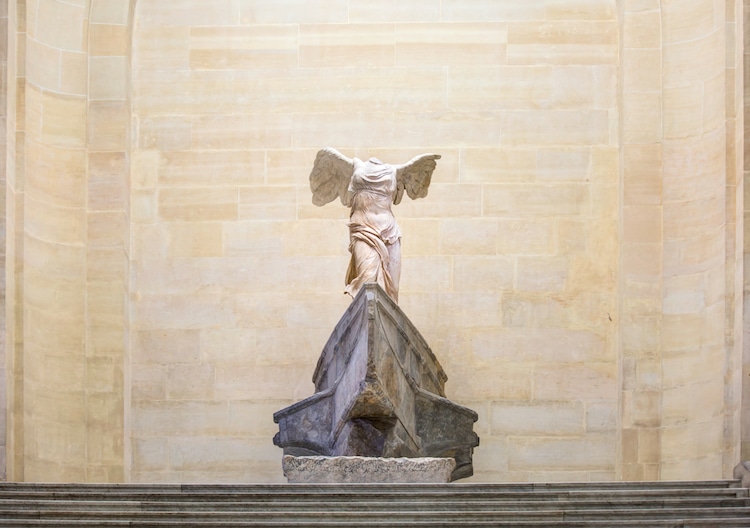 |
| The Winged Victory of Samothrace, Estimated: 323 BCE-31 CE, Artist Unknown |
The Winged Victory of Samothrace, also known as the Nike of Samothrace, is a Hellenistic marble sculpture of the Greek Goddess Nike sculpted around 190 B.C.E,. Standing 18 feet tall, she is depicted standing in triumph at the bow of a ship, the marble appearing to be cloth clinging to a wet body. Like other statues sculpted during this time period, there is an intense focus on realism, making you believe that the sculpture was moving and halted in time. Analyzing the sculpture, you will find that her weight looks naturally distributed on her legs, a classical depiction of vigor and triumph that you see in Hellenistic sculptures. Ninety years after discovering the statue, a piece of her hand was found. Archaeologists believed her hand would be in a fist as if holding something but instead, her hand was opened and extended looking as if greeting someone. Despite this, it is believed to be a sculpture to commemorate a successful sea battle on the island of Rhodes given the way her body stance is depicted, wide-winged, and dramatically stepping forward. Before being excavated, this statue stood proudly on the Greek island, Samothrace, in the northern Aegean Sea, over an artificial lake (for a more dramatic effect). This island was the home of Poseidon during the Trojan War, leading the people to view it as a safe haven from the dangers of the sea. To ensure their protection, the Samothrace people built a sanctuary for the gods, erecting sculptures of several sea oriented sculptures such as the Winged Victory, important ships from battles, and even columns with sea-like decoration on them. Knowing this, we are provided an insight into how the ancient world viewed the Samothrace people. Because of the Samothrace's written history of being visited by gods, large city projects were carried out on the island, and Greek-ambassadors were allowed to permanently reside on the island and carry out the wills of the people during the Roman occupation during the time. Not only was it a very important sculpture during the time of creation, but it still is an important sculpture today, holding a piece of remembrance for eternity. The sculpture now is visited by over 15,000 people a day and sits in the Louvre museum in Paris, France.
Sources:
Cartwright, Mark. “Samothrace.” Ancient History Encyclopedia. Ancient History Encyclopedia, July 7, 2016. https://www.ancient.eu/Samothrace/.
Richman-Abdou, Kelly. “This Armless Sculpture Is One of the Louvre's Most Treasured Masterpieces.” My Modern Met, September 8, 2020. https://mymodernmet.com/winged-victory-of-samothrace/.
The British Museum, "Ancient Greece, an introduction," in Smarthistory, February 28, 2017, accessed September 11, 2020, https://smarthistory.org/ancient-greece-an-introduction/.
Wednesday, September 9, 2020
Alabaster Cinerary Urn
| Alabaster cinerary Urn | 3rd century B.C., Artist Unknown, Etruscan Culture |
Long before the village of Rome became famous, the centralized culture of Italy was that of Etruscan. They were never a unified state of civilization, so it is important to emphasize that the Etruscans were not a civilization despite meeting several criteria of being one. One of the important characteristics is the centralized government and cities, which to our knowledge, they did not have. What we do know, is that the Etruscans flourished between 800-300 B.C.E., their rich mineral resources, and trading power making them able to focus on things such as art. Because there are not many remains in terms of writings, we do not know much about their day to day culture, what they did, their thoughts, their economics. What we do know, is that Etruscan art is very expressive and energetic. Unfortunately, because of their conquering by the Romans, the Etruscan language and culture ceased to exist. Despite being absorbed with Roman culture, their greatest legacies are their funerary works of art and remains of burial rituals. This funeral based art includes tomb paintings and beautiful sculptures of mythology surrounding urns.
This piece of art is known as the Alabaster Cinerary Urn. The woman on top of the lid is relaxed and elaborately dressed with a large necklace around her neck and a fan in her hand. The bottom of the urn is very intriguing compared to the lid of the urn. The bottom half depicts a battle, a pair of warriors fighting warlike women, called Amazons through Greek Mythology, and the Etruscan demon of death, Vanth. What is very intriguing to me is that Vanth is not a punisher of the dead, how demons are usually depicted in doing. But rather, she is depicted as a caring figure, taking the dead to care for them, with broad wings coming out of her back. The urn could be described as a final act of care for the deceased, with Vanth looking over their ashes allowing them to have a relaxed and leisure filled afterlife as depicted in the relaxed woman on the lid.
One of the main reasons why this not only an interesting piece of art but an important one as well, is the extensive nature that the Etruscans went through to ritualistically bury their dead. Not only were they buried in tombs, but they were also buried with goods. And not just some coins and a satchel of fruit, but things like their beds, their baby cradles, things you typically don't see with burial rituals. Because their funeral art is one of the only remaining indicators of their culture, it is important to try and understand the cause for the art to understand their rituals and practices because we do not the literary resources and evidence to study it outside of the realm of art.
Sources:
Cartwright, Mark. “Amazon Women.” Ancient History Encyclopedia. Ancient History Encyclopedia, September 19, 2020. https://www.ancient.eu/amazon/.
Cartwright, Mark. “Etruscan Art.” Ancient History Encyclopedia. Ancient History Encyclopedia, Accessed September 9, 2020. https://www.ancient.eu/Etruscan_Art/.
Etruscan. “Alabaster Cinerary Urn: Etruscan: Hellenistic: The Met.” The Metropolitan Museum of Art. Accessed 9 September 2020. https://www.metmuseum.org/art/collection/search/246269.
Hemingway, Colette. “Etruscan Art | Essay.” metmuseum.org, October 2004. https://www.metmuseum.org/toah/hd/etru/hd_etru.htm.
Wednesday, September 2, 2020
The Uruk Bull (Week 2 Discussion)
| Fragment of a bowl with a frieze of bulls in relief (3300–2900 B.C.E) Artist Unknown, the Uruk Culture |
For years, Mesopotamia has been the center of civilization. Hunting, fishing, farming, religious practices, are believed to have started in this region. Uruk, commonly known as The First City, played a key role in the starting urbanization of Mesopotamia. Not only did Uruk become the center of urbanization, but it also became one of the most important religious centers during this time. The city was constantly inhabited from as early as 5,000 B.C.E. to the 5th century C.E. Because of how long the culture of the Uruk has influenced lives, it is important to analyze the remains of their civilization to understand why cities began to urbanize and socialize the way they did.
To understand the artwork above, we need to fully comprehend the pantheon surrounding the Mesopotamian region. One of the most prestigious gods of this pantheon was Marduk, a deity known for compassion, healing, fairness, magic, and sometimes even worshipped for agriculture and storms. The beginning of his name is linked to bull figures, Marru meaning 'bull-calf'. Linking this, the bull was considered sacred in Mesopotamian cultures, being a figurine of divinity to the people of the time. This artwork here is a piece of a bowl depicting a procession of bulls though, only one full-body image of a bull has survived over the years. The artwork is fully three-dimensional, developed at the end of the fourth millennium B.C.E. This is important to note because art being this fully rendered and holding an anatomically well-depicting nature is uncommon for this early time period. Artwork during this time period usually depicts exaggerated features such as an oversized head, shortened limbs, or widened legs, none of this is what we see here on the bowl. The bowl was made of steatite, commonly known as soapstone, and chlorite, a sheet mineral usually green in color with an oily feel to it. Fragments similar to this piece have been found in palaces and religious places, giving the thought that these bowls were used in rituals of some kind. Given the historical background with the Mesopotamian pantheon, one can hypothesize that these bowls were of religious rituals, possibly used in crowning ceremonies of kings and used in day to day blessings of important individuals.
Citations:
“Fragment of a Bowl with a Frieze of Bulls in Relief.” Metmuseum.org, The Metropolitan Museum of Art, www.metmuseum.org/art/collection/search/324111.
“The History of Uruk.” Uruk Project, Western Sydney University, staff.cdms.westernsydney.edu.au/~anton/Research/Uruk_Project/History.html.
Mark, Joshua J. “Marduk.” Ancient History Encyclopedia, Ancient History Encyclopedia, www.ancient.eu/Marduk/.
Monday, August 24, 2020
Introductory Post
Hello! My name is Luna. I am a sophomore in college and am also a psychology major with a minor in anthropology (sociocultural if you want specifics). I plan to develop a career in either sociocultural research or be a clinical psychologist and provide therapy for clients. I really enjoy reading and drawing, especially fantasy characters and fantasy books.
Here is a picture of myself:

The Pyramid of the Moon
Teotihuacan Pyramid of the Moon, Completed in 250 C.E., Mexico City, Mexico Teotihuacan is believed to be the first large chief city of an a...
-
 Nose Ornament with Intertwined Serpents, Moche, Peru, 390-450 C.E., The MET The Moche were not a single unified people, nor were they con...
-
 Lydenburg Head, Lydenburg, South Africa (500 C.E.) The Lydenburg Heads were a series of seven terracotta sculptures found in Lydenburg, So...
-
 Teotihuacan Pyramid of the Moon, Completed in 250 C.E., Mexico City, Mexico Teotihuacan is believed to be the first large chief city of an a...